
By Seth W. Jones, ADHD and Executive Functioning Specialist
You can play a video game for four hours straight, but struggle to get started on an important project that’s due a week from now.
If that sounds familiar, you’re in good company. I know that feeling well. I have ADHD myself, and for a long time I thought it meant something was wrong with me. Lazy. Unmotivated. Not trying hard enough. It took me years, first as an elementary school principal and now as a coach, to understand what was really going on.
Here’s where I’ve landed: ADHD is misunderstood. It isn’t really about attention. It’s about time, and how we perceive it. And the best way I’ve found to explain that is with a picture.
Most people navigate time like they’re on a sailboat. They feel the wind on their face, they see the horizon, and they sense themselves getting closer with every move.
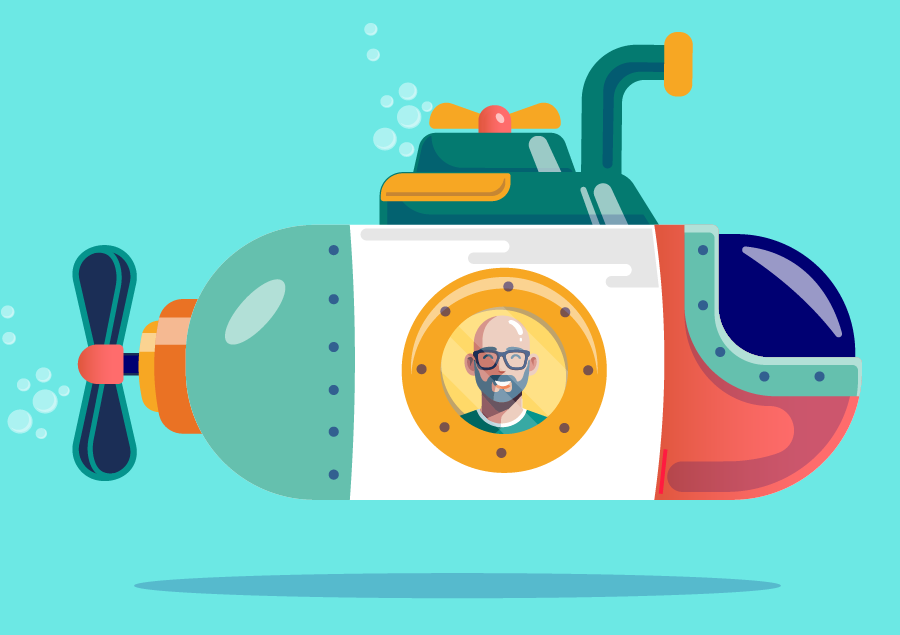
Those of us with ADHD navigate time more like a submarine.
This post is a tour of life down there: why the easy stuff swallows hours, why deadlines feel fake until they feel terrifying, why small mistakes hit so hard, and what actually helps. Let’s go below deck.
1. The Ping: Why the Easy Stuff Swallows Hours
It’s darker in a submarine. You can’t just look out the window and see where you are. So to know where you are, you send out a signal and wait for something to echo back. A ping.
When we get pings, we move. When we don’t, we drift, or we go looking for something that will ping back. Usually it’s our phone.
That’s why the video game wins. We have plenty of attention. What we struggle with is aiming it toward something that doesn’t answer back. The game answers back. Every move gets a response, and every level tells you you’re making progress. The email just sits there, silent.
So if you’ve ever wondered why the easy stuff swallows hours and the important stuff won’t start, it might not be you. It might just be that nothing’s pinging back yet.
2. The Periscope: Seeing the Deadline Isn’t Feeling It
You knew about the deadline for weeks. You weren’t ignoring it. You just couldn’t feel it.
Down in the submarine, we do have a periscope. And when urgency finally hits, we pop it up and there it is: the shoreline, clear as day. The paper. The project. The bill. But the sea is rough, and waves keep washing over the lens. We catch a glimpse, and then it’s gone again.
And here’s the thing nobody tells you: seeing it isn’t the same as feeling yourself move toward it.
Russell Barkley, whose research shapes so much of how I work, puts it simply. ADHD isn’t a problem of knowing what to do. It’s a problem of doing what you know. Most people can imagine the finished task and feel a little bit of that reward right now, and that feeling carries them forward. For us, that inner fuel runs thin. So we can stare right at the shoreline and still feel like we’re not moving at all.
That’s not a character flaw. It’s how the submarine works. And once we understand that, we can stop asking “why can’t I just do it?” and start asking a better question: “what would help me feel like I’m getting closer?”
3. In Range or Out of Range: Why Thursday’s Deadline Feels Fake on Monday
Why does Thursday’s deadline feel fake on Monday and terrifying on Wednesday?
Remember, down here we find our way by sending out pings and listening for the echo. Anything close enough to echo back feels real. Anything too far away just goes silent.
So for those of us with ADHD, time is either in range or out of range.
That deadline on Monday isn’t unimportant, and we haven’t forgotten it. It’s simply out of range. No echo, no signal, nothing to tell us it’s really there. Then on Wednesday it suddenly comes into range, all at once, and every alarm starts going off.
This is what people usually call time blindness- although time myopia is more accurate. It’s not that we can’t tell time or can’t see the future at all. It’s that the future doesn’t feel real until it’s close enough to ping back. Most people have a longer range. They can sense Thursday from Monday. Ours is shorter.
The good news is that range can be extended. Breaking a project into pieces, setting a check-in with a friend or coach, putting a mini deadline on Tuesday: each one is a way of bringing the future into range before the alarms go off.
4. Cramped Quarters: When Working Memory Runs Out of Room
You walked into the kitchen and forgot why.
Submarines are tight on space. There isn’t much room to store things, so you can only keep a few items within reach at once. Pick up something new, and something else gets set down and forgotten.
That’s working memory. It’s the mental workbench where we hold information while we use it: the reason we came into the room, the three things we needed from the shop, the question we were about to ask.
With ADHD, that workbench is smaller. I can hold about two things at once on a good day. Add a third, and one of them slides off.
For a long time I thought that meant I just needed to try harder to remember. But you can’t try your way into more storage space. What you can do is stop relying on the inside of the submarine.
Write it down. Say it out loud to Siri. Put the note where you’ll see it. Ask someone to hold that thought for a second. Every one of those moves the cargo outside the cramped quarters, so your mind is free to steer.
5. No Life Raft: Why Small Mistakes Feel So Big
One small mistake, and suddenly you’re questioning everything about yourself.
On a sailboat, if something goes wrong, there’s a life raft. You can see the shore, the sky, other boats. A mistake is a problem, but you know you’ll be fine.
In a submarine, it doesn’t feel that way. It’s deep, it’s dark, and every wrong move feels like it could be the one that sinks you. Whether or not that’s true, the stakes feel enormous.
That’s a big part of living with ADHD. Barkley describes emotional regulation as one of the core executive functions, and when it’s harder for us, feelings arrive bigger and faster. A missed appointment doesn’t feel like a missed appointment. It feels like proof that we’re failing at life.
Here’s what I’ve learned: the goal isn’t to stop making mistakes. We’ll make them. The goal is to recover faster. To say, “Okay, Seth, it happened again. You just need to own it, make it right, and let it go.”
The submarine has more safety systems built I than I remember. One wrong move rarely sinks the ship. I’ve been traveling this way for 50 years and haven’t sunk yet.
6. Hovering on the Ocean Floor: Procrastination as Protection
Doing nothing isn’t restful. It just feels safer.
When you’ve made enough wrong moves in the dark, a strange thing happens. The safest option starts to look like not moving at all. So the submarine sinks to the ocean floor and hovers there. No collisions. No mistakes. Nothing to get wrong.
That’s what procrastination often is for people with ADHD. Not laziness. Protection. If I don’t start the paper, I can’t write it badly. If I don’t open the email, I don’t have to find out what’s inside. Sitting still feels like safety.
But the ocean floor has a catch. The deadline keeps moving closer whether we move or not, and eventually it finds us down there, with the alarms blaring and no time left to steer.
So the question isn’t “what’s wrong with me?” It’s “what feels so risky about starting?”
And here’s the hard truth: breaking it into smaller steps on your own often isn’t enough. Down here, we can’t tell whether we’re on course, and we can’t risk crashing again. What gets us off the ocean floor is a ping from outside. Someone who says, “Yes, that’s the right direction.” A friend who reads your first paragraph. A coach who checks in midweek. Even an AI assistant can answer back when no one else is around. It’s not a replacement for people, but it’s a ping all the same.
We don’t need someone to drive the submarine. We just need someone to answer back.
7. The Pain: Running on Emergency Power
You do your best work at 2 a.m. the night before, and you’re exhausted from living that way.
When nothing pings back, there’s still one signal that always gets through: the pain. The panic. The deadline that’s suddenly in range and blaring every alarm in the submarine.
And it works. That’s the trouble. Urgency gets us to shore. Papers get written, projects get done, bills get paid, just barely.
But running on emergency power drains the batteries. I recently met someone who told me she’s burnt out on urgency. It’s the only thing that gets her across the finish line, and it’s wearing her down.
That’s what it costs to rely on pain. Every task becomes a crisis. Every success feels like a near miss. And over time, we start to believe crisis is the only way we can work.
It isn’t. It’s just the only signal we’ve been getting.
8. The Ping or the Pain: Building Signals on Purpose
So what if you didn’t have to wait for the pain?
Down in the submarine, there are only two signals that reliably get us moving: the ping or the pain.
The pain will always come. Deadlines arrive, consequences land, alarms go off. But the ping is something we can choose. We can build it in on purpose, long before the alarms ever sound.
A friend sitting with you while you work. A text that says, “How’s it going?” A coach who checks in midweek. A partner who offers a gentle cue, given with love, not frustration. Even an AI that answers back at 10 p.m.
Each one says the same thing: you’re here, you’re moving, you’re on course.
Never Meant to Travel Alone
If you’ve recognized yourself somewhere in this post, I hope you’ll take this away with you: the submarine was never the problem.
It goes deep. It notices what others miss. It can stay focused for hours when the signal’s strong. It just was never meant to travel alone.
That’s really the heart of my work. Not fixing the submarine, and not trying to turn it into a sailboat, but helping people build the pings that let them steer, so they can stop living from one alarm to the next.
If you’d like a ping of your own, I’d love to hear from you. You can learn more about coaching at adhdcoachseth.com.
More pings, and less pain.
Seth W. Jones