Most people think ADHD is about attention, and most of us with ADHD have spent years being told some version of “you could do it if you just tried harder.” Researchers like Dr. Russell Barkley have spent decades showing that ADHD is really about executive functioning and self-regulation: the mental machinery that lets us hold a goal in mind, plan the steps, manage our emotions along the way, and act now for a reward that comes later.
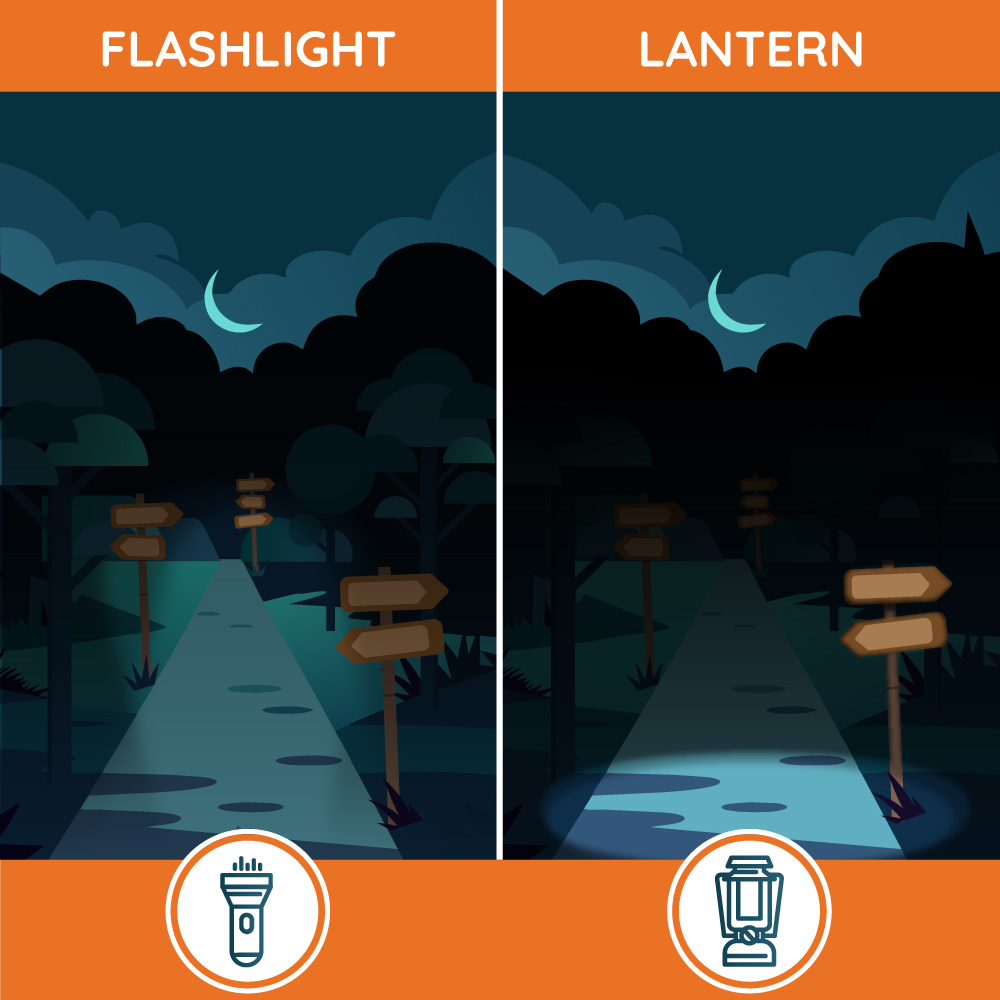
That science is enormously important. It can also be dense, clinical, and, as I discovered on a tropical beach, surprisingly painful to hear. So the image I keep coming back to is a simple one. Most people carry a flashlight. People with ADHD carry a lantern.
Part One
What ADHD is, and what it isn’t
ADHD is about self-regulation
ADHD isn’t about attention. It’s about self-regulation: our ability to capture our thoughts, decide whether or not they’re valid, and when they are valid, take steps toward accomplishing our future goals, toward making real what we want to become our reality. This is where we tend to get stuck in our own thoughts. We don’t know how to start, and we default to scrolling on YouTube, playing games, and so on.
Where the lantern comes in
The analogy is light. I think there’s a divine source of light within all of us. When we’re expressing that light, when it flows through us, when we’re in that flow state and it feels like we’re doing what we’re called to do on earth, things come into focus. That’s when we’re able to harness that light.
For people with ADHD, myself included, harnessing that light can be a real challenge. Again, it’s not that we don’t have enough attention. It’s that I’ll have so many thoughts competing in my mind at one time that it’s almost as if I’m holding a lantern that governs my internal light: my awareness, my potential, all of those things. But my hand isn’t able to keep that lantern steady, so the light bounces all over the place. I feel stuck and overwhelmed, and I end up wanting to escape.
Most people carry a flashlight
Most people light the world and their experiences with an internal flashlight. They’re able to direct that flashlight and point it where they want to go. They can see the destination, as well as each of the steps it’s going to take to get there. They can then hold that light in their minds and see themselves accomplishing those tasks as they actually make progress toward getting things done, bringing that experience to light for themselves and for the people around them.
What it’s like to carry a lantern
People with ADHD have more of an internal lantern. This is an analogy, so it’s not actually a visual problem, although it sort of is. I may be able to read the signpost up ahead briefly, but I can’t hold it in mind as I go about accomplishing a multi-step problem or a long-term project. I know what it is intellectually, but I don’t have the internal bandwidth or space to hold that idea in place and keep it in mind as I take steps toward it.
That is, until urgency finally brings it into the light where I can see it. If the light from my lantern extends seven or eight feet around me, and most people can see thirty to fifty feet ahead, I have to wait until something is urgent and pressing before I can actually see it, feel it, and hold it in my head.
The criticism we carry
For those of us who’ve been called lazy our whole lives, what matters most is the internalization of all that criticism over time. We start to believe that this is our fault, that we’ve had a flashlight all along. That’s what we’ve been told by people with good intentions. Because they have a flashlight, they assume we have one too, and that we’re just choosing not to use it.
ADHD and self-acceptance
When a client sits down across from me carrying all of that, the first thing I help them see is self-acceptance. It’s realizing that we’ve always had a lantern. We’ve never had a flashlight. We don’t need to fix ourselves or fix our broken flashlight. We need to accept that we have a lantern, that we’ve always done the best we could, and then learn strategies to increase the light from our lantern, which is the natural way we light and process the world.
Executive functioning: a lantern for a day, or a lantern for life
People sometimes say, “Oh, I’m a bit ADHD too.” What the lantern analogy is meant to illuminate is our executive functions. Not everybody has ADHD, but everybody has executive functioning. You may have a strong flashlight, but if you’ve only gotten two hours of sleep two nights in a row, you’re going to experience what it feels like to have a lantern. That will be remedied by sleep.
People with ADHD experience the shortcomings of having a lantern chronically. That’s an important distinction. Everybody knows what it’s like to get a headache. Not everybody knows what it’s like to live with migraines.
Connection extends the light
What I’ve found extends our light more than anything is connection with others. We tend to show up more for other people than for ourselves. If I know somebody is counting on me to bring pretzels the next day, or else they’re going to be hungry, there’s a good chance I’ll be motivated to get the pretzels. But then I have to take another step and make sure I leave them in front of the door or put them in the back seat of my car, so when I wake up tired in the morning, I don’t have to rely on my working memory.
More than anything else, it really is connection. Another thing that helps, and it’s related, is pings. It’s almost like our lantern is extended through sonar, by hearing beeps and whizzes in the present moment. That’s highly motivating. Because of rejection sensitivity, and because we made so many mistakes early in life, we tend to give up easily. So hearing feedback, encouragement that we’re on the right track, having somebody notice what we’re doing and give us positive feedback, really helps extend the light.
Unfortunately, because so many people with ADHD are highly motivated to avoid shame, embarrassment and failure, we tend to go internal and develop a hard shell to protect this wound from early in life. Then we don’t let others in. We don’t ask for help. And then we don’t receive the connection that’s so important to our motivation.
Letting people back in
How does someone who’s been hurt for years learn to let people back in? Slowly.
But what I’m really trying to say with the lantern metaphor, more than anything, is that we don’t go very far alone. The more we try to protect ourselves and stay safe, the more stuck we are.
The people who stand in my light
I have quite a few people who stand in my light. My wife is a very important piece of my life, although it’s important that she doesn’t act as my coach. We’ve worked out ways for her to give me cues. When I start to feel like things are against me, or that I’m a victim in a situation, because I get trapped in my thoughts, we’ve agreed well ahead of time that she’ll say, in a sort of high-pitched voice, “Sounds like you’re being a victim.” I take that input, and then I go for a walk or process through things.
I’ve also developed a network of other coaches that I meet with consistently, who are willing to give me feedback and look at things with me, which brings things into the light where I can see them. A lot of people with ADHD, like me, are kind of stuck in the now. In order to really think, or to push back on ideas, even talking things through with an AI helps me, because I know it’s going to hear what I’m saying and respond with feedback, either helping me refine the concept or encouraging what I’m saying when it’s consistent with my written philosophy.
Knowing our limits
If there’s one thing to remember about our lanterns, it’s understanding our limitations. Our operating system is never going to be that of a high-powered flashlight. I’m always going to need other people to help me think through ideas. Left to my own devices without feedback, I tend to wither on the vine. I’m fifty years old; this isn’t going to change.
The more I develop love for myself and then connect with other people in a loving way, the more light comes out of my lantern. It’s in isolation that I wither. I still need downtime, because the world can be a lot, but I have to be very careful that it doesn’t shift toward isolation. I think there’s been so much talk about ADHD since the pandemic because it’s really isolation that brings about our biggest struggles.
Never a broken flashlight
You were never a broken flashlight. You’ve always been a lantern. That’s the paradigm shift. It moves us from “I’m a screw-up, and my life could have been so different if I’d only done X, Y and Z.” That story we tell ourselves is false. It isn’t true, because we didn’t have the words for it, and neither did anybody else when we were young. We realized we didn’t have a flashlight, but we didn’t accept it. So we pretended we had one and decided we were just bad or broken. I think that’s the most important thing.
“You were never a broken flashlight. You’ve always been a lantern.”
Part Two
How I found my lantern: an ADHD diagnosis at 23
My first year of teaching
I first realized I was carrying a lantern during my first year as a teacher, when I was twenty-three and really struggled to follow through. I think I had always known something was off with my brain. I just desperately didn’t want to believe it was true. I wanted to believe I just chose not to use my flashlight, that there was something sneaky or bad or dishonest about me.
Without realizing it, I had become a perpetual people pleaser. Growing up, I really honed my empathy muscles, so I could anticipate what people wanted to hear and then use my verbal abilities to tap dance around what I’d neglected to do. I used those same skills in my career in education. But without enough executive functioning, without the ability to organize information or hold things in working memory, I was about to get found out and potentially lose my job.
So I went to a psychiatrist, went through the process, and within a few weeks was diagnosed with ADHD. The psychiatrist said I checked literally all of the boxes. I started taking stimulant medication, and the sustained attention it gave me, the ability to focus deeply on reading, on writing, and on incorporating different strategies into my practice, let me develop some strong teaching chops, be effective with students, and go on to do a lot of leadership work in schools.
ADHD medication wasn’t self-acceptance
Medication helped me focus, but self-acceptance was still missing. In a way, the medication let me double down on my belief that I was a pretender. I got a master’s degree in education and did really well in the program with the help of that medication, but I didn’t think the success was mine. I attributed it to the pills. I even questioned whether I really had ADHD and whether I should be getting them, or whether I was being sneaky and would eventually get exposed if the medication ran out.
I didn’t understand what executive functioning was throughout most of my career. It wasn’t until social-emotional learning standards came out, the CASEL work on self-awareness and social awareness, and our counselors were providing professional development, that it really struck a chord with me. This wasn’t something I shared, but something I thought about a lot. At first it hit me with a lot of shame: how had I come so far in life without having developed these competencies within myself?
Eventually I burned out, because I used urgency to constantly motivate myself. After sixteen or seventeen years as a school administrator, it left me. Toward the end of my career, I really couldn’t even get out of my chair. That’s when I took a leave of absence, started working with an ADHD coach, and took a huge deep dive into ADHD research, especially hyperfocusing on the work of Dr. Russell Barkley and executive functioning.
The Russell Barkley audiobook I hated
When I first found Barkley, I hated him. I was on vacation with my wife somewhere warm and tropical, listening to one of his books on audio, and I remember being so upset, thinking, oh, he says this in such an offensive way. It really hit a nerve. Without being dressed up in any flowery language, it cut to the quick of my core issue of perceived incompetence.
Then I started to really understand, and dove deeper into what was meant by inhibition, working memory, emotional regulation, and all of the work on planning, and how much of that is done inside people’s minds. It really hit me that I didn’t have the cognitive room to turn things over in my head and tap into hindsight and foresight. And then it became really clear that my next step was to work as an ADHD executive functioning coach, to help people gain the awareness I’d gained through this research. It was one of the most powerful experiences of my life.
Before the lantern, there was urgency
The lantern came about three or four years later. When I started out as a coach, so many people wanted to know how to navigate life without urgency, and I couldn’t tell them. I didn’t have the words, and I couldn’t find them no matter how much I researched. So I landed on leveraging urgency, encouraging people to work with their brains instead of against them. It’s okay to wait until the day before the paper is due; then schedule things, make sure you have everything, and start work then.
Then I started to understand more about the importance of connection, and I encouraged people to set up frequent meetings with their professor, their supervisor, or whoever was working on their court case, so there’d be urgency the day before each meeting. Again, working with your brain instead of against it.
Dr. Barkley has an extremely strong flashlight, if not a spotlight, that he navigates the world with. So unpacking his words and trying to make these concepts easier for people to understand became a bit of an obsession. And then one night I was walking my dogs with a flashlight, and it all came to me: the lantern and the flashlight, and how it really is about perceiving. It’s really about seeing, about not being able to hold the idea in mind while working on it.
The night walk
That night I was looking off into the distance, walking the dogs with a flashlight, and then my wife joined us on the walk. As we were talking and I was shining the light, I noticed she has a very strong flashlight. My first thought was, well, I guess I have a flashlight with low batteries, or one that can’t shine far enough. But then I realized that didn’t make sense. So I started playing around with lanterns, looking at the light and the warm glow, and the lantern really started to make sense.
I think there’s a challenge with all the talk about ADHD being a superpower, because it’s a challenge, and it’s a challenge that doesn’t really go away. I was just trying to capture something people could understand and generalize, and that’s where the lantern framework came from.
Part Three
ADHD strengths: what a lantern lights up
Reading people, finding patterns, meeting emergencies
A lantern lights everything around it at once, including the people nearby. I think what it sees comes from a combination of a predisposition to having a lantern and what happens when you’re growing up and you know something is wrong, but you’re not sure what it is, and you really want to deny it. As kids, going back hundreds of thousands of years, I think we equate rejection with survival. No one in my family ever overtly rejected me, but something inside me said I had to keep this a secret and cover it up, no matter the cost.
Something flipped, and I really started paying attention to what other people were doing and saying, and receiving validation through their approval. I don’t think it was conscious, but I spent a lot of time honing those empathetic skills. So my lantern, at least, is really good at reading other people’s emotions and sitting with people during difficult times.
And this seems to happen with lots of lanterns: we’re able to find patterns, and after turning ideas over and over again, we come up with fairly simple solutions to complicated problems. My problem-solving ability is what led to being promoted into school leadership. It certainly wasn’t that I was the best teacher in the school. And I don’t love the not now, so long-term planning, budgeting and all the calendar things most school administrators are good at weren’t strengths of mine.
I was really good in the now. I could solve problems and talk things through with people. I was good at distributive leadership, building the capacity of those around me and empowering others. And I was really good in emergencies. I think that’s probably what lanterns excel at more than anyone else, because emergencies take place in the now, not in the future.
Why the chatter stops
People might assume time slows down for me in an emergency. Maybe it’s not that time slows down. It’s more that all of the future thinking goes away. All my cognitive energy is one-pointed at whatever emergency is happening. All the other mental chatter goes away, and I’m fully focused and present. And when I’m fully focused and present, I can use deductive reasoning. I’m good at thinking on my feet.
I’ve always been very good at reactive sports. I loved hacky sack and ping pong, things where you don’t really have to think, where you almost have to turn your mind off. But golf and baseball and other sports you have to think through a lot weren’t strengths of mine, because I tend to overthink.
So my overthinking stops, I’m fully present, and I just authentically show up as my true self. And he’s pretty awesome.
“I just authentically show up as my true self. And he’s pretty awesome.”
Part Four
The wound: rejection sensitivity, masking and shame
As far back as I can remember
Honestly, the wound goes back as far as I can remember. I remember being four or five years old on a train, and there were these women laughing and giving me positive attention, and I remember feeling unworthy of it, because I had a hard time knowing what was happening. My mind has wandered and struggled to focus on one thing, as opposed to everything else, for as long as I can remember.
Then came the wound of realizing in school that I couldn’t answer the question, and thinking I was dumb, that there was something in me that was broken, or uniquely f*cked up in some way. That was sort of confirmed in fourth grade, when I was identified as having a learning disability in visual processing. A lot of people with ADHD have co-occurring conditions, often anxiety or depression. In my case, it’s also a learning disability. My ability to read a map or know where I am in space is really limited, and I am sure this also affects how I see the world and how I see myself.
Trying to mask or cover up that wound has been the longest obsession of my life. I want to appear calm and collected on the outside, while on the inside I’m on fire or falling apart and anxious. It’s a feeling of never being completely confident that I’m right, because I can see so many different perspectives and angles. And while I think quickly on my feet, during in direct confrontations, I flood easily and struggle to find the right thing to say in the moment.
That feeling of being broken on the inside, and needing to protect it from other people, meant I’d sometimes only meet my needs in private. The first time I drank or smoked marijuana, a lot of those ping-pong thoughts in my head went quiet, and that became the escape. It became too much of an escape, and that’s why I spent the decade of my forties without drinking. I got sober because my life, at least my life outside of work, had become unmanageable.
So much of that has to do with the wound, the self-protecting, and of course the people pleasing. Being able to people-please and empathize served me very well at the beginning of romantic relationships. But eventually it would come to a head. No matter what I did or said, the truth would come out, and when my weaker points were out for everybody to see and I couldn’t hide them anymore, I’d become defensive. I’d snap, or go through shame spirals. That became pretty detrimental in romantic relationships.
When things fell apart
My response to the wound started to change when things fell apart, in public ways.
In my mid to late thirties, my marriage fell apart. My wife and I separated and divorced. I didn’t respond by listening, reflecting and owning my part. I blamed my ex-wife for how things went, and I quickly jumped into a relationship with another woman. That relationship was pretty disastrous. We got married and divorced within a couple of years.
The part of my life where I still had success was my career as an elementary school principal. Even after my personal life fell apart, I was still able to protect my wound and project success at work, until I burned out of the principal job after using urgency for so long. So I took a job as a project manager in a school district, where most of the work required future thinking, which is not a strength. Predictably, it ended in disaster.
So now I’d experienced embarrassment and what felt like humiliation. The veneer I’d maintained my whole life, of looking one way to others while experiencing something else, cracked, in both my personal and professional life. I had to really sit with it. Eventually I realized I wasn’t a victim. I had long-standing difficulties I hadn’t addressed.
I’d been doing a lot of therapeutic and spiritual development throughout that time, so I had a base to examine and reflect on myself. But once I experienced public failure, it opened a way for me to reflect honestly, with less defensiveness, and eventually to realize that ADHD was behind all these struggles. It was my defensiveness around my executive functioning challenges that kept me apart from others. It was a protective shell I thought was keeping me safe, but what it was really doing was acting as a barrier, keeping other people’s love from connecting with me, and keeping me from seeing both the love within them and the love within myself.
This is still a work in progress. I am by no means an enlightened human. But I’m closer on the path, and working with ADHD clients regularly helps me remember both my struggles and my gifts. That helps keep me grounded.
“It was a protective shell I thought was keeping me safe. What it was really doing was keeping love out.”
Part Five
Extending the light: ADHD strategies that help
Living openly
Once the shell cracked, I entered a new romantic relationship with my wife, Holli, by being openly ADHD. I wasn’t trying to mask or hide these tendencies. I was pretty open about them, and through that I was able to live more authentically.
When problems came up that in the past would have brought rampant defensiveness, I was able to recover quicker. It still happens, but in a way that’s more socially acceptable, because there isn’t as much inner resistance to who I really am. My struggles and my gifts are equally a part of me.
Not everything is perfect, but it’s by far the most open and honest relationship I’ve been in. Do I still struggle with people pleasing? Yes. It’s something I have to actively work against. But all of the self-love, not hiding, and being willing to expose my soft underbelly has made a big difference.
Telling the truth for a living
In my career, there had always been an element of inauthenticity. I don’t love to admit it, but I was good at the verbal tap dancing, making a system appear more loving and caring than it was in reality.
As an ADHD executive functioning coach, I don’t hold much back. I’m able to live in integrity and talk about the challenges I’ve experienced in a way that uses these painful experiences to help others. That has offered me a freedom I’d never experienced before.
My previous careers also required a lot of work in the not now. As an ADHD coach, ninety percent of my work is in the present moment. Afterward I need to write up my notes, do the billing and other business things, but for the most part I now live in a way that’s set up around my strengths, in an environment where a lantern can really thrive.
Small ADHD strategies to start with
For someone who can’t change careers tomorrow, I think the first step is self-acceptance. It’s acknowledging that you’ve always done the best you could, and that’s a hard thing for people to accept. As long as the illusion is there that you could have done it if only you’d tried harder or shown up for it, the illusion of control is still there. It still seems possible, even if you haven’t done it so far.
Acknowledging that you’re a lantern really means you have to accept help from other people. Going it alone and isolating is the recipe for being stuck. So that means being willing to ask a coworker for a check-in time, or saying, “Hey, can I process this idea with you? We can set a five-minute timer.” It means taking a walk to clear your head, or using some very brief breathwork exercises during the workday to calm your mind.
And a lot of the people I work with end up changing careers. If you spend most of your time in the not now, and it’s a struggle to get there, that might be a reminder that you could do things differently.
Mindfulness and men’s work
I’ve also done a lot of coaching work and trainings around mindfulness. And I did a lot of men’s work, going on retreats where I’d open up about my feelings with groups of men and say things I’d always just thought. I developed deeper, more open relationships, became more comfortable showing emotion, and got a lot of practice in authentic living, which was all new.
Part Six
Where the light comes from
The light has always been ours
I believe that light comes from the divine. Part of my journey has been a spiritual awakening, seeing myself as connected with my source, where everything began. Believing in a higher power, something bigger than me that I’m part of, takes a lot of the pressure off. It helps quiet a lot of those voices, because I know those voices and ideas are really based in fear.
The two real emotions are fear and love. Whenever I’m feeling scarcity, or not enough, or I’m afraid, angry or resentful in a situation, it’s about identifying all of that as fear-based, and then connecting in a spiritual way so I can reframe and look at things from a loving perspective. With emotional regulation, it doesn’t take much to trip me up and send me into a negative spiral. So it’s all about catching it, being kind to myself, having some self-compassion, and then coming back to being present, still, loving, accepting and forgiving. Seeing this light in myself, and seeing it in others.
The light has always been ours. We become disconnected from source as soon as we’re born, and life is a struggle until we realize it has always been with us, not apart from us.
We don’t go very far alone
If any of this sounds like your story, I want you to know that the story you’ve been telling yourself isn’t true. You were never a broken flashlight. You’ve always been a lantern, and you’ve always done the best you could. And you don’t have to walk this road alone.Work with Seth
Seth W. Jones · ADHD and Executive Functioning Specialist · Learning and Behavior Specialist · Eugene, Oregon